
Silvapedia
The SRFB's species fact sheets
Drawing on its expertise and know-how, the SRFB has gathered a large amount of information over the years on many forest species, whether well-known or more obscure.
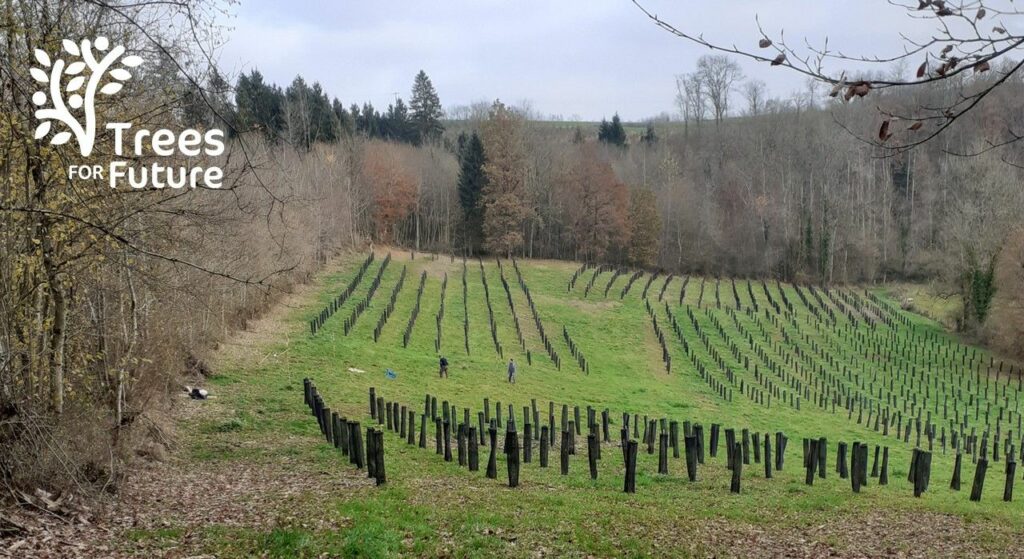
This knowledge notably includes essences tested as part of the project Trees for the Future.
To share this knowledge base with its members, the SRFB has developed species sheets accessible exclusively via the’Member area.
Each sheet broadly covers the essence: recognition criteria, ecological requirements, silviculture, technical characteristics of the wood, potential applications... Regarding the technical aspects of wood as a material, the sheets benefited from valuable information and a thorough review by Wood Info Wood whom we thank for this collaboration.
The collection is presented in accessible language, while remaining technically rigorous and precise.
This knowledge base, named Silvapedia, is regularly to be enriched by the publication of new fact sheets.

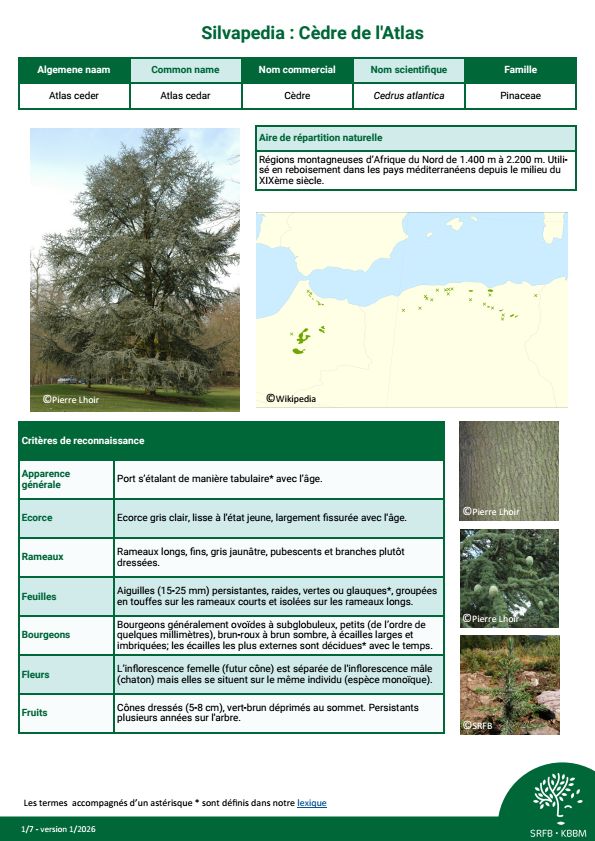
Découvrez un échantillon de ce travail en accès libre avec le Cèdre de l’Atlas
Fancy reading more?
| Motor | Definition |
|---|---|
| Anaerobiosis | Condition of a low-oxygen environment, unfavourable to root respiration. |
| Bark | The peripheral zone of the wood, physiologically active, ensuring the conduction of raw sap. |
| BRINELL (N/mm²) | Brinell hardness measures a wood's resistance to being dented or crushed. A small metal ball is pressed into the wood with a precise load, and the indentation it leaves is measured: the smaller the indentation, the harder the wood. This is a simple indicator for comparing woods: a wood with a high Brinell hardness will be more resistant to wear, impact, and sawing, while a softer wood will be easier to work but less resistant. |
| Cyanogenic | Plant capable of producing compounds releasing hydrocyanic acid. |
| Decidueye | Species losing its foliage annually during the unfavourable season. |
| Dragons | Shoots arising from adventitious buds on the roots, ensuring vegetative reproduction. |
| Drupe | Fleshy stone fruit containing a single seed. |
| Natural durability | The European standard EN 350 defines the natural durability of wood against wood-destroying fungi and, separately, the natural resistance to wood-boring insects for most European wood species. Resistance to insects is not classified by levels but using a binary principle («sensitive» or «non-sensitive») depending on the species involved. The main insects that attack wood in buildings are: the house longhorn beetle (Hylotrupes bajulus), which mainly attacks conifers; Lyctus beetles, which primarily attack hardwoods rich in starch; and the common furniture beetle (Anobium punctatum), commonly known as a «woodworm». |
| Heartwood | Heartwood, physiologically inactive, generally more durable. |
| Monoscent essence | Species in which a single individual bears distinct male and female flowers. |
| Edaphic requirement | Species' requirements regarding soil characteristics (texture, pH, drainage, fertility). |
| Bundled (rooting) | Root system comprised of numerous roots of similar diameter, with no dominant taproot. |
| Gemmotherapy | Therapeutic use of plant embryonic tissues (buds, young shoots). |
| Grungy | Root-guiding culture container to promote functional rooting. |
| JANKA (N.) | The Janka hardness test measures a wood's resistance to indentation by a standard-sized steel ball. The ball is driven halfway into the wood, and the force required is measured. The higher the value, the harder the wood and the more resistant it is to impact and wear. This measure is widely used to compare wood species for flooring, furniture, or cladding. |
| Lenticels | Small openings in the bark that allow for the exchange of gases in the tree. They appear as slightly raised dots or slits, often lighter or darker than the bark, and their shape varies depending on the species. |
| Bulk density | The ratio of the mass of wood to the total volume it occupies, including voids. It depends heavily on the moisture content and is generally given as 12 % |
| Young's modulus (E) | The modulus of elasticity measures a wood's ability to bend or deform under a load without breaking. In practice, it indicates how well a piece of wood returns to its original shape after being bent or compressed. The higher the value, the stiffer the wood and the more resistant it is to bending. This data is useful for choosing suitable species for load-bearing structures, beams, frameworks, or elements subjected to loads. |
| MONIN (mm) | Monnin hardness is a measure of wood's resistance to crushing under a load distributed over a square or rectangular surface. The wood is pressed with a press meter and the resistance to deformation is measured. The higher the Monnin value, the firmer and more solid the wood. It is particularly useful for timber intended for construction, sawing or load-bearing structures. |
| Phenolic compound | Natural substance found in wood and bark, belonging to the family of aromatic molecules, which plays a role in protecting the tree against fungi, bacteria, and insects. Common examples: tannins, lignin. Polyphenol |
| Polyphenol | Natural substance found in wood and bark, belonging to the family of aromatic molecules, which plays a role in protecting the tree against fungi, bacteria, and insects. Common examples: tannins, lignin. Phenolic compound |
| Phototropism | The orientation of plant organ growth in response to light. |
| Phytoncide | Substance produced by certain plants with antimicrobial or antifungal properties. |
| Plastic (petrol) | Essence demonstrating a strong capacity for adaptation to varied situational conditions. |
| Relative humidity between 40% and 601% | Dimensional variation of wood in indoor conditions. |
| Relative humidity between 60% and 90.1% | Dimensional variation of wood in outdoor conditions, related to hygrometric variations. |
| Longitudinal withdrawal | Dimensional variations of wood in the fibre direction during drying. This shrinkage is very low compared to other directions. |
| Radial removal | Tangential shrinkage of wood, perpendicular to the grain, from pith to bark, during drying. |
| Rt / Rr | Ratio of tangential withdrawal to radial withdrawal, an indicator of dimensional stability. |
| Summary | Said of a tree whose crown is partially or totally overshadowed by neighbouring, taller trees, receiving lateral or reduced light, which can limit its growth in height and diameter. |
| Tabular (port) | A port characterised by a wide, spreading, and flattened crown. |
| Thermophile | Species that favour warm environments and high temperatures. |
| Zoochore | Seed dispersal by animals. |
| Mucron | A short, sharp, abrupt tip that ends the extremity of a Plant organ, most often a leaf, sepal or bract. |