
New species and provenances
Introducing new species and provenances in response to climate change: daring or reckless?
The Royal Belgian Forest Society's position on future forests
No, foresters do not want to transform our forests into a widespread eucalyptus plantation with the sole aim of producing wood! What we want is to preserve the structure and multiple functions of our forests as much as possible, and to encourage the associated biodiversity as much as possible. According to the Société Royale Forestière de Belgique (SRFB), the introduction of new provenances/species is only one of the solutions in this respect, to be combined with ALL the others, in space and time. These introductions must be carried out in a selective and targeted manner, taking into account the associated risks, and must be rigorously monitored.
Introduction
There are very few forest areas that are not currently affected by climate change. A large majority of foresters agree that we need to change our practices. The introduction of new species/provenances adapted to a warmer, drier climate is being experimented with as part of the Trees for Future or similar projects in neighbouring countries. This is just ONE of the proposed strategies for adapting forests to climate change, along with others such as greater use of natural regeneration, soil protection, more dynamic forestry, mixed forestry with continuous cover, increasing biodiversity, etc. All these methods have their merits, and SRFB advocates combining them rather than opposing them.
However, the introduction of new species/provenances into forests gives rise to a great deal of debate. These mainly concern two aspects:
- the potential impact that these new species/provenances have/have on biodiversity and ecosystem functioning.
- their role in adapting forests to climate change and health crises. Some advocate their introduction because they are better adapted to current and future conditions, while others maintain that our native species will adapt naturally.
On both the first and second aspects, SRFB is taking a nuanced approach, because no adaptation option can be ruled out and none can be advocated as the only solution.
Summary
The introduction of tree species and production-oriented monoculture are often wrongly associated, because silvicultural models are not only linked to tree species but also, and even more importantly, to the objectives pursued and the area under consideration. On this issue, as on any other, we need to get away from the trap of one-size-fits-all thinking. For example, shouldn't the notion of the exotic be assessed in terms of time? Shouldn't the notion of indigénat (indigenousness) tend towards a continental definition?
There are many debates surrounding the introduction of new species/provenances, particularly in terms of their impact on the environment and biodiversity. While caution is called for, don't they have their place in helping forests adapt to climate change and health crises? But what strategies should we adopt when it comes to introducing new species/provenances in order to minimise the risks? Shouldn't the risks be measured according to the nature of the species introduced, the silviculture method chosen and the host ecosystem?
This article looks at some of these questions.
Essences from here and elsewhere: a long history
In the collective unconscious, the forest often inspires an idea of eternity and immutability. However, this is not the case: the forest has always changed, it's just a question of timing.
On a broad time scale, these changes are linked to natural phenomena such as continental drift and ice ages, which have shaped forests over geological time. For example, the dominant position of beech in our regions dates back only 3,000 to 4,000 years, a very short time compared with the 400 million years that separate us from the appearance of the first trees!
On a «shorter» scale, a very recent animal species has had a particularly strong impact on its environment, including forests: mankind, through its many civilisations! From overexploitation to reforestation, man has profoundly modified not only the surface area but also the composition of forests.
European history, in particular, is full of examples, both happy and unhappy, of the introduction of species, particularly plant species, into forests and elsewhere. What would our landscapes and our food supply be without maize, beans, tomatoes, wheat, plane trees, poplars, potatoes and so on? Not all of these plants are native to the European continent, yet they make a major contribution to its landscapes and economy.
On the other hand, the disastrous consequences of the introduction of Japanese knotweed, Giant hogweed and Himalayan balsam no longer need to be proven.
In our forests, too, many species are the result of introductions, and while an old chestnut tree poses no problems for anyone, a late cherry tree can pose major management problems.
We feel it is important to define certain terms here1.
- Indigenous or autochthonous: describes a taxon, population or animal or plant community recognised as originating in the territory where it is currently found. (Note: the notion of administrative territory (region, country) is obviously irrelevant here).
- Exotic or allochthonous: describes a taxon, population or animal or plant community introduced voluntarily or involuntarily outside its natural range.
- Naturalized: describes an allochthonous species that has settled in a region other than its area of origin, and is capable of reproducing there on a long-term basis and spreading spontaneously, thus integrating the existing ecosystem (e.g. black locust), Robinia pseudoacacia).
- Invasive species: a species that locally takes up a position that can be considered excessive within an ecosystem, in relation to a dynamic power that is locally superior to others (e.g. the sycamore maple, by forming dense and pure facies, can be considered invasive within a beech wood with woodruff).
- Invasive species: an allochthonous species which, due to the absence of its own set of regulators, has particularly effective reproduction strategies and forms locally invasive populations. It can have a major impact on the ecosystems it colonises, replacing native species which it helps to make rare or extinct, and blocking certain ecosystems through its dynamic cover (e.g. Asian knotweed), Reynoutria japonica and Reynoutria sachalinensis).
These definitions evoke a relatively fixed and rigid situation. However, as indicated above, the distribution area of a species varies over time as a function of climate variations (for example, the natural distribution areas of holm and downy oaks are currently declining in southern Europe while they are expanding in the north). The time scale envisaged should not, therefore, lead us to consider the current state of the forests as definitive, all the more so in the current context.
The low diversity of tree species in Europe
European forests are inhabited by a small number of species compared with North America or Asia, for example. The relative paucity of our stands can be explained by the successive ice ages (the last of which ended around 12,000 years ago), which have considerably depleted our flora. As the climate cooled and warmed, species migrated southwards and northwards respectively. However, these natural migrations were hampered by the configuration of the mountain ranges (Pyrenees, Alps) and the Mediterranean Sea, which were obstacles that many species were unable to cross. This is how Europe lost Liquidambar, tulip tree, sequoias and other species that are still found in Asia and North America (where the north-south orientation of the mountain ranges did not hinder the migration of species).
Reduction and disappearance of native species
Some tree species, while not necessarily threatened with extinction, are seeing their range of favourable sites reduced as a result of climate change. For example, beech, the dominant native deciduous species in many forest habitats, can no longer find optimal conditions for growth in low-lying areas and is dying out in the driest sites.
Unfortunately, it's not just the vagaries of the weather that can damage our capital in terms of species diversity. New diseases, sometimes imported, are also a threat. Younger foresters are no longer familiar with elm. This species, once widespread in Europe, has been decimated by a fungal disease, graphiosis, since the 1970s. The species has virtually disappeared from our forests, and its use in forestry has been forgotten. Let's hope that the research programmes currently under way will help foresters to avoid a similar story with our common ash, which is exposed to chalarosis.
Under the combined effect of the climate and health crises, we are therefore witnessing a gradual decline in the range of native species available, the subsequent simplification of ecosystems and their functioning, and the loss of the associated biodiversity.
Benefits and risks of introducing new species/provenances
A list of recommendations has been issued by a panel of experts2 to adapt forests to climate change and make them more resilient. It includes the following points in particular:
- Strictly adapting species to the site and silviculture to the species;
- ensure good soil structure using appropriate farming techniques;
- maintain game populations in balance with the forest's carrying capacity ;
- diversify tree species and maximise genetic diversity ;
- encourage the assisted migration of southern species and origins.
The introduction of new species/provenances is clearly in line with the last two recommendations. The ultimate aim of all these measures is to maintain healthy, multifunctional forests in a context of climate change, in terms of production, regulation and cultural services.
This type of introduction must take into account the risk of negative impacts on the host ecosystem. These impacts may be biological (competition with and suppression of native species), structural (e.g. destabilisation of banks by Japanese knotweed), economic (e.g. cost of combating late cherry in regenerations) or landscape-related.
A new species that spreads effectively across the landscape could lead to a loss of biodiversity linked to its ability to eliminate others and its inability to host the local flora and fauna. The loss of biodiversity could be accompanied by disruptions to ecosystem functioning and lead to the loss of associated ecosystem services.
It is therefore both legitimate and essential to consider the potential for a new species to cause harm before deploying it on a large scale. The introduction of a new species, as with any new species, must therefore be subject to a risk analysis and an assessment of the risk/benefit balance.
What strategy should you choose?
Two visions are being debated: greater use of natural regeneration to encourage certain adaptive phenomena (mutations, selection) or the introduction of new species/provenances to encourage others (mainly gene flow and hybridisation). There are advocates of the former solution and others of the latter. In SRFB's view, the debate lies elsewhere: it mainly concerns the speed at which forests can naturally adapt to the rapid climate change that is impacting them.
In reality, there is nothing to stop several approaches being combined, and it seems unreasonable to us to rely on just one, whatever it may be. It would seem wise to favour one or other approach depending on the context and to adjust the cursor according to the specific issues linked to the stands to be renewed. In any case, whatever the option(s) chosen by the manager, there is still a great deal of uncertainty. It is the diversity of the scenarios chosen on a global scale (natural regeneration, planting, type of mixture, choice of species and local or new provenances) that will maximise the chances of conserving a resilient forest.
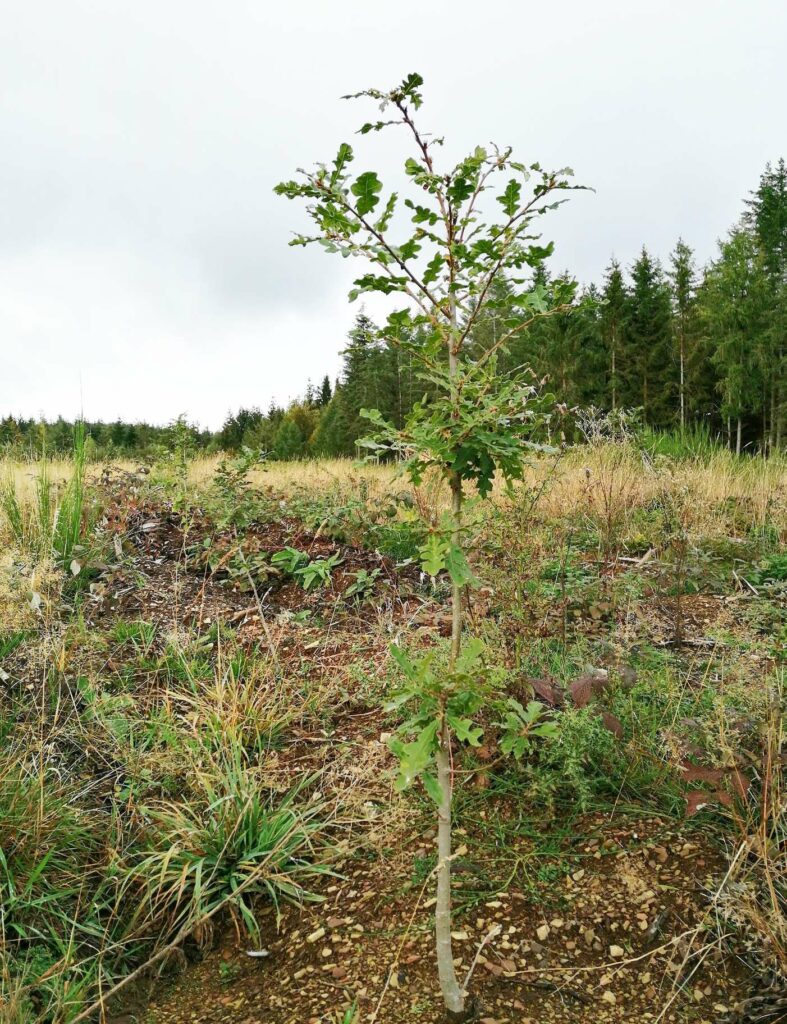
Hairy oak in a test plot of Trees for Future
Towards a continental definition of indigénat?
Over the course of their long existence in a given area, native tree species have developed a multitude of interactions with the local flora and fauna. It is all these interactions that give the forest ecosystem its complexity and give sub-natural old-growth forests their biological value.1. A species is said to be indigenous if it occurs naturally (without any recent or past intervention) and if it has been cultivated for a long time.2, This is the term used to describe the species (direct or indirect human activity) present in a given area. The notion of indigenousness therefore depends on the geographical scale considered. Should a species naturally present in Rochefort be considered indigenous to Famenne, Wallonia, Belgium or Western Europe? The decision is relatively arbitrary, but can have a major influence on forestry policy, particularly in terms of legislation. For example, a species considered indigenous to Flanders (e.g. Scots pine) could be considered indigenous to the rest of Belgium.3) and which can therefore be planted throughout this territory, including in Natura2000 and in sub-natural old-growth forests, may be considered non-native in Wallonia, or vice versa. In the case of Scots pine, for example, a national definition of indigenousness would certainly change the situation.
Given that administrative boundaries, whether national or regional, cannot be transposed to biological species, including trees, and given that climate change is progressively modifying the climatic envelopes of tree species, would it not be more appropriate to consider indigenousness at a continental level? Over the course of glacial and interglacial periods, it is likely that tree species have come into contact with each other. We can therefore consider that species from southern Europe have a history of interaction with local flora and fauna.
In policies for introducing new species, should a species such as Hungarian oak (Quercus frainetto) not be considered indigenous to Europe and therefore not be subject to the same restrictions as a species of Asian origin (e.g. Manchurian ash) or North American origin (e.g. redwood) which has no history of interaction with local flora and fauna and which, a priori, presents a lower biological potential and a higher invasive risk? Shouldn't it be considered as indigenous to Europe and therefore not subject to the same restrictions as a species of Asian origin (e.g. Manchurian ash) or North American origin (e.g. evergreen redwood) which has no history of interaction with local flora and fauna and which, a priori, presents a lower biological potential and a higher invasive risk?
- Sub-natural: describes vegetation that has a certain natural character, but masks, often incompletely, traces of past human activity (agro-pastoral, materials extraction, etc.). Source: Vocabulaire forestier. Écologie, gestion et conservation des espaces verts, Christian Gauberville, Yves Bastien - CNPF-IDF - 2011.
On this subject, see the article by Thierry Kervyn, Marc Herman and Jean-Pierre Scohy «The age of Wallonia's forests. A look back, for a better view of the future» published in Silva Belgica 2/2021. PDF available on request from silva.belgica@srfb-kbbm.be - Without a precise definition of time: see bottom of next page.
- Whether Scots pine is indigenous to Belgium is still a matter of debate. It is thought to have been sown for the first time in Belgium in 1675, in the Campine region. Source: Ecological file of tree species.
Towards a differentiated approach
In order to consider the introduction of a new species as potentially problematic, it must be difficult to control its dispersal in the environment into which it is introduced AND its arrival in the ecosystem must significantly disrupt its functioning.
The levels of risk, both in terms of ecosystem disruption and excessive dispersal, depend in particular on the origin of the species. An introduced species can become invasive in its new environment if the latter lacks the pathogens and predators that regulate it in its area of origin (Enemy release hypothesis3). Par conséquent, une essence originaire du sud de l’Europe, ayant co-évolué avec les herbivores, les insectes, les bactéries et les champignons présents en Europe, aura une probabilité moindre de devenir problématique en étant introduite chez nous qu’une essence d’Asie orientale ou d’Amérique du Nord, car cette dernière arriverait dans un environnement dépourvu de son cortège d’organismes régulateurs. À l’inverse et pour les mêmes raisons, le potentiel biologique (capacité à héberger la biodiversité indigène) est plus élevé pour les essences européennes que pour les essences d’autres continents (par exemple : le chêne pubescent ou le chêne de Hongrie sont capables d’héberger davantage les espèces animales, fongiques et végétales associées à nos chênes indigènes que les chênes américains).
In view of the above, it is clear that the approach can be differentiated according to the nature of the species in question, the ecosystem into which it is introduced and the way in which it is introduced (on what surface, as a mixture, to enrich natural regeneration, or as a monospecific species, etc.).
The Belgian forest, and more generally the forest of north-western Europe, has different facies and not all forests have the same challenges. For example, the adaptation of old sub-natural forests, whether protected or not, should not be considered in the same way as that of more recent forests planted in the 20th century with deciduous or coniferous trees on farmland or moorland. The former are of great heritage interest. They concentrate most of the biodiversity that is typical of forests, and their adaptation should preserve their functioning and structure as much as possible. The latter are more «cultivated» forests with less heritage and biodiversity interest. Their adaptation will aim to maintain sustainable timber production, while increasing the resilience of stands to climatic and health hazards, using appropriate silvicultural techniques that also benefit the other functions of sustainable forest management.
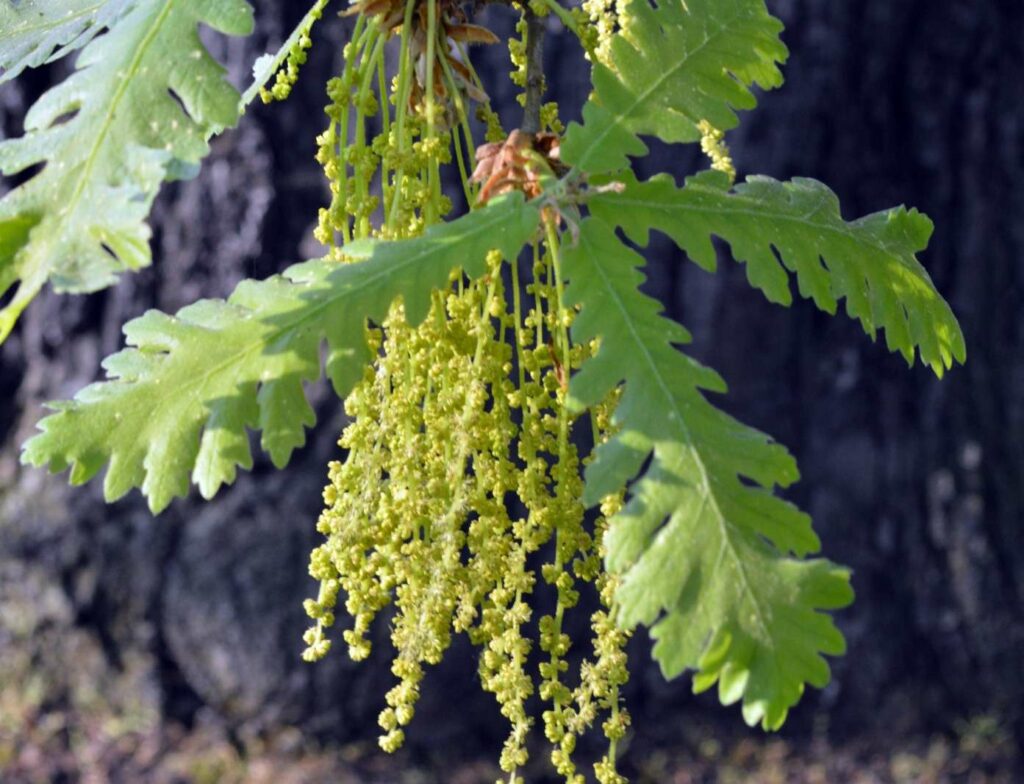
Twig of Quercus frainetto (Hungarian oak)
Sub-natural old-growth forests
In sub-natural ancient forests, the major challenge is to maintain the integrity of these forests, the animal and plant species they shelter, their structure, their genetic diversity, their functioning and their productivity. In a context of stable climate, the natural regeneration of existing tree species, provided they are in good condition, is a key factor.4, Natural regeneration is often the best solution for meeting all these challenges. In a changing climate, however, natural regeneration may not be enough to ensure the long-term resilience of stands.
For example, for the renewal of sub-natural old-growth forests, we could adopt a gradual approach based on a prior diagnosis.
- If the species in place are in station, that the prognosis for their future is good (see for example, the maps of climatic compatibility of Climessence), and that the adult trees are of good quality and show no symptoms of decline, then natural regeneration alone remains a perfectly valid option. However, care should be taken to ensure that regeneration is carried out in such a way as to maintain the most drought-resistant species (increasing the proportion of sessile oak in beech forests, for example) and rare species (wild cherry, wild cherry, etc.).
- If the species in place are currently doing well but the climatic prognosis for them is uncertain, the introduction of individuals of the same species but from a more southerly origin (e.g. Sessile oak from the south of France, common beech from Italy, etc.) into the natural regeneration could be envisaged to strengthen the stand's genes and increase its capacity to select (naturally and via hammering) robust and adapted individuals. This is known as assisted provenance migration.
- In the most difficult sites, where existing species are likely to be in great difficulty (sessile oak stands on filtering soil, lowland beech stands, chalarose ash stands, etc.) and where dieback has already been observed, natural regeneration should be used with caution, favouring less represented but better adapted species (e.g. sessile oak in ash stands): sessile oak in the ash grove) and supplementing this with species that are potentially better adapted to the new/future conditions. These could be uncommon native species (small-leaved lime, plane maple, nannyberry, etc.), native species of southern provenance or new species. However, given the great heritage and environmental value of sub-natural old-growth forests, there are strong reservations about introducing southern provenances and new species, which are reflected in a number of legislative restrictions.
Sub-natural forests on difficult sites
In the context of sub-natural forests on constrained sites, enrichment could be envisaged along three distinct lines.
- Enrichment with native species poses no real problem, as long as the right species/station ratio is respected.
- L’introduction de nouvelles provenances d’essences indigènes ou de nouvelles essences biologiquement similaires à nos indigènes ou ayant une limite nord d’aire de répartition naturelle proche (hêtre commun du Sud du Massif central, chêne pubescent, chêne chevelu, pins méditerranéens européens…) mérite également d’être envisagée, tout en pesant raisonnablement le pour et le contre. Par exemple, l’avantage des chênes blancs européens (chêne pubescent, chêne de Hongrie, chêne tauzin) est qu’ils peuvent se croiser avec les chênes blancs du nord (sessile et pédonculé). Considérer ce phénomène comme de la pollution génétique serait ignorer l’histoire récente des forêts européennes. En effet, toutes ces essences étaient, il y a environ 10.000 ans (un battement de cils à l’échelle de l’évolution biologique), concentrées et en contact dans de petits territoires du Sud de l’Europe (les fameux refuges glaciaires : péninsule ibérique, Italie et Balkans). L’hybridation des chênes du sud avec nos chênes locaux devrait plutôt être vue comme un avantage, puisqu’elle aurait le mérite de combiner les gènes de résistance à la sécheresse avec ceux de la résistance au froid. Par ailleurs, comme mentionné précédemment, les espèces de chênes européens ont co-évolué avec la faune et la flore du continent. Par conséquent, au sein du genre Quercus, le potentiel d’accueil de la biodiversité des chênes européens introduits est le plus proche de celui de nos chênes indigènes.
Il pourrait être également intéressant de diversifier les essences secondaires en gardant en point de mire le critère de proximité géographique afin de limiter les risques d’invasion et de maximiser le potentiel biologique. Ainsi, à côté des merisiers, alisiers et autres tilleuls à petites feuilles indigènes, pourraient être introduites des essences comme le noisetier de Byzance (Corylus colurna) ou le frêne à fleurs (Fraxinus ornus), par exemple.
These enrichments would be carried out in moderate quantities and proportions to ensure a good mix of native Belgian species and European species/provenances.
SRFB is in favour of diversifying old-growth forests with a view to maintaining (or restoring) the proper functioning of these ecosystems. - On the other hand, the introduction of exotic species from Asia, North America or elsewhere seems to us to be premature in the context of old-growth forests. In-depth research into their various potential impacts on the ecosystem and the extent of these impacts must be carried out before any significant introductions of these species are made, especially as the other two options already offer numerous possibilities for adaptation and resilience.
Recent forests (with or without conifers)
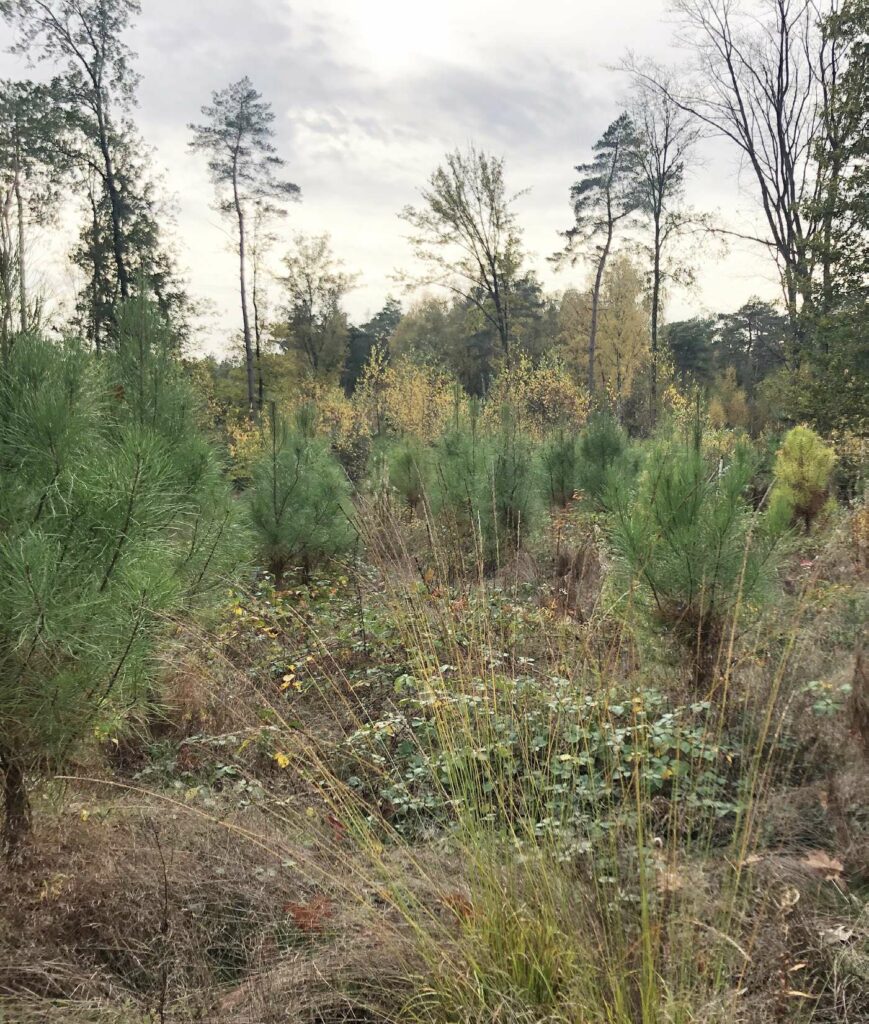
Maritime pines installed in a Trees for Future test plot
In recent forests, which are predominantly coniferous (and therefore already largely dominated by exotic species) and essentially monospecific, species diversity is currently low (mainly spruce, Douglas fir, larch and pine) and the production issue is predominant. The biodiversity found in these stands, apart from a few species associated with old conifers (crested kinglet, Tengmalm's owl, etc.), is mainly associated with the open areas created by clear-cutting, in which the species of the old heaths (callune, quaternary heather, etc.) can continue to thrive. The major challenge here is to maintain quality timber production, mainly for local processing, while striving to increase the diversity and resilience of the stands. This means diversifying species. In addition to the observed reduction in the preponderance of spruce in our forests, particularly on sites that are no longer suitable for it, and its gradual replacement by the other usual softwood species (Douglas fir, larch, pine), there is also a tendency to diversify plots, particularly after sanitary felling (bark beetle), and to test other species, mixtures and innovative itineraries. The plots made available to Trees for Future, Most of these are sanitary spruce cuttings.
The SRFB proposes to favour new experiments in recent forests where the ecosystem has been impoverished by old agricultural practices. This leaves more room for daring and experimentation, and it seems to us that the restrictions on the use of new exotic species should be less here than in sub-natural old-growth forests.
Thus, in recent coniferous or deciduous forests, stand renewal, particularly when the transformation (change of species) follows a health problem, should be able to rely on the full range of introductions, subject to a few specific precautions:
- use southern provenances of native or exotic species already listed in the Ecological Species File (e.g. Douglas fir of Californian origin).5) ;
- use southern species that are biologically close to native species (e.g. Hungarian oak in relation to pedunculate oak) or exotic species listed in the Ecological Species Register (e.g. Mediterranean fir in relation to silver fir and/or Vancouver fir);
- use new species, in particular softwoods of American, North African or Asian origin, but only on a select basis and only in small areas. These plantings must be carried out on an experimental basis and in a very controlled manner (see also below).
- comply with all relevant legislation, particularly in terms of installation surface area, as stipulated in Article 40 of the Forestry Code6.
In terms of planting schemes, we can of course proceed, as in sub-natural old-growth forests, by enriching the natural regeneration at specific points. However, full planting of these new species, possibly mixed with others with complementary functional traits, is a good option (islands of future in the sense of the mosaic forest).
For trials of new species originating from other continents, a thorough evaluation (prior to trials and during trials) is required before any large-scale deployment. In the context of Trees for Future, on the basis of the available literature and the experience accumulated in historical arboretums, several potentially promising species at the outset were discarded. We can cite, for example, Manchurian ash, which is potentially invasive and a healthy carrier of chalarosis, or Lawson cypress, whose potentially invasive nature has recently been highlighted7.
Selected species which have passed these initial checks but which nevertheless prove to be invasive, within or from the test plot, must naturally be abandoned and the plot destroyed.
These trials of new species are likely to increase in size over the next few years. In France, for example, where there is a deliberate policy of setting up "islands of future" in public forests, the objective over the next 20 years is to achieve forest cover equal to 0.5% of the total forest area. In France, the surface area for these islands is of the order of two hectares, limited to 0.5 hectares in Wallonia.
Conclusion
Assisted migration of southern provenances and species and the introduction of species from other continents are just some of the strategies used to adapt forests to climate change. They complement methods such as increased use of natural regeneration, dynamic silviculture, respect for the soil and mixed forestry with continuous cover...
While we cannot reasonably rule out any risk of invasion or negative impact on ecosystem functioning linked to these introductions, the approach proposed by the SRFB in this article minimises these risks as far as possible. It has the merit of proposing a way forward for the adaptation of forests to climate change, with a view to maintaining ecosystems in good working order. In our view, it is more risky to continue management «as usual» than to experiment with enriching the forest with new species and new methods.
The task of today's foresters is no longer primarily to maintain the integrity of typical forest associations (the alder-beech forest, for example), but above all to maintain the structure and functioning of our forests. As a result, they will be able to continue to exist and perform their essential social, environmental and economic functions.
About the introduction of new species or provenances, SRFB considers three categories of new species/provenances, each with its own level of associated risk and deployment strategy.
- Southern provenances of native species: negligible risks (e.g. sessile oak from the south of France). They should be able to be used to enrich plantations and natural regenerations of local provenances of the same species in all situations, including sub-natural old-growth forests. They would thus increase the overall genetic diversity of the future stand.
- European species of southern origin: low risk (e.g. downy oak, maritime pine, etc.). These species are biologically close to our native species (some may even hybridise with them), their biological potential is similar and the risk of invasion very limited. The introduction of these species for enrichment is not very risky and should be encouraged, including for the diversification of sub-natural old-growth forests if the native species in place are at the limit of their station.
- Species from other continents: higher potential risk (including invasiveness) and lower biological potential (no history of coexistence with native flora and fauna). The SRFB recommends that these species should not be introduced into old sub-natural forests and should be reserved for reforestation of recent forests, ideally as a mixture. For new species that have not yet been tested in forests in Belgium or neighbouring regions, they should be planted as part of well-defined trials (for example Trees for Future). The plots will be clearly identified so that their behaviour can be monitored over the long term, before they are deployed on a larger scale and, if necessary, they can be easily destroyed.
In conclusion, it is forestry know-how and scientific knowledge that make all the difference between daring and recklessness when introducing new species or provenances in response to climate change. We are living in a period of great uncertainty, and we believe it is important to open up the field of possibilities, to be able to question ourselves and to take measured risks. With this in mind, we are arguing for a combination of strategies rather than opposing them, for nuance rather than dogmatism. New species/provenances have their place in an overall approach to adapting our forests to climate change, provided they are used with full awareness of the potential risks and benefits.
Klimaatbomen project
At the end of 2022, the ANB (Agentschap voor Natuur en Bos), the Flemish forestry administration, published a call for projects entitled «Opmaak van een lijst en begeleidend document met aangepaste boomsoorten en herkomsten voor Vlaanderen in functie van klimaatsverandering».
The aim was to commission one or more organisations to carry out research into the adaptation of Flemish forests to climate change and to compile a list of species and provenances (native and exotic) capable of ensuring the continuity of the forest cover and its many functions.
La SRFB a répondu à cet appel avec l’équipe du professeur Bart Muys de la KULeuven et le Bosgroep Zuyd Nederland (Pays-Bas). C’est notre consortium qui a remporté le marché. L’approche originale que nous proposions a, en effet, retenu l’attention du jury.
The approach developed by the partners is innovative in that it is based on the notion of functional traits (as defined by Christian Messier). The list of species and provenances proposed will include species with functional traits that are currently lacking or that will potentially disappear in certain forest ecosystems because they are currently associated with species that are sensitive to climate change. Within the project, the KULeuven will be responsible for the strictly scientific part, with the analysis of climate models and functional trait databases. The Bosgroep will be consulting Dutch and German experts, while the SRFB will be gathering the experience of Belgian and French experts. On this occasion, it will also carry out an in-depth analysis of the data accumulated in its network of arboreta in Trees for Future.
The project began in December 2022 and will run for 1 year. We'll tell you more about it in a future issue of Silva belgica.
Written by
- Nicolas Dassonville: Head of Trees for Future at the Royal Forestry Society of Belgium
- Pascaline Leruth: Communications Officer & Forest Friends at the Royal Forestry Society of Belgium
Legend
- Definitions taken from «Vocabulaire forestier. Ecology, management and conservation of green spaces», Christian Gauberville, Yves Bastien - CNPF-IDF - 2011.
- See: «Climate change and its impact on Walloon forests. Recommendations for decision-makers, owners and managers». Document downloadable from http://biodiversite.wallonie.be/servlet/Repository/changements-climatiques-brochure-recommandations-2017.pdf?ID=38830
- Keane & Crawley. Exotic plant invasions and the enemy release hypothesis. Trends in Ecology and Evolution. 2002;17:164-170.
- It is not uncommon, for example, for the pedunculate oak to have been wrongly favoured on sites where its water supply is unsatisfactory, which partly explains the oak dieback observed today.
- The Belgian Douglas are originally from Washington State.
- Art. 40: «With the exception of artificial regeneration along avenues or on areas of less than fifty ares in a single block per five hectares of woodland and forest belonging to the same owner, any artificial regeneration using species that are not in optimal or tolerated condition, according to the Ecological Register of Species published by the Government, is prohibited, unless an exemption is granted by the Government.»
- Fanal A., Mahy G., Monty A. & Fayolle A. (2021) Les conifères exotiques en forêt wallonne : état des lieux dans les arboretums forestiers. Forêt.Nature 161 : 41-48