How can you get your children
and grandchildren involved in managing the family woodland?
Attracting the interest of future heirs
Future heirs are sometimes not very interested in managing family woodlands. This observation led to the idea that it was necessary to sow the seed of forestry passion in them from a young age.
This can be done by creating a strong emotional bond between the child and a group of trees – the Klump– followed since childhood.
The Klump, how does it work?
One Klump, or cell plantation, is a planting of a cluster of 25 trees (hardwood or softwood) planted closely together in the open or under the canopy of mature trees. The small area to «look after» allows for investment (time and money) in each Klump for its protection (individual protections) and its maintenance (clearances, pruning and trimming). The long-term objective is to achieve, through progressive trimming, a high-quality tree for the future in each cell.
The Klump as a tool for diversifying your livestock
The klump technique makes it possible to diversify stands and possibly introduce new species into them. In particular, it is a method that should be favoured to encourage the establishment of species of southern origin (assisted migration).
The benefits of Klump in terms of forest management education
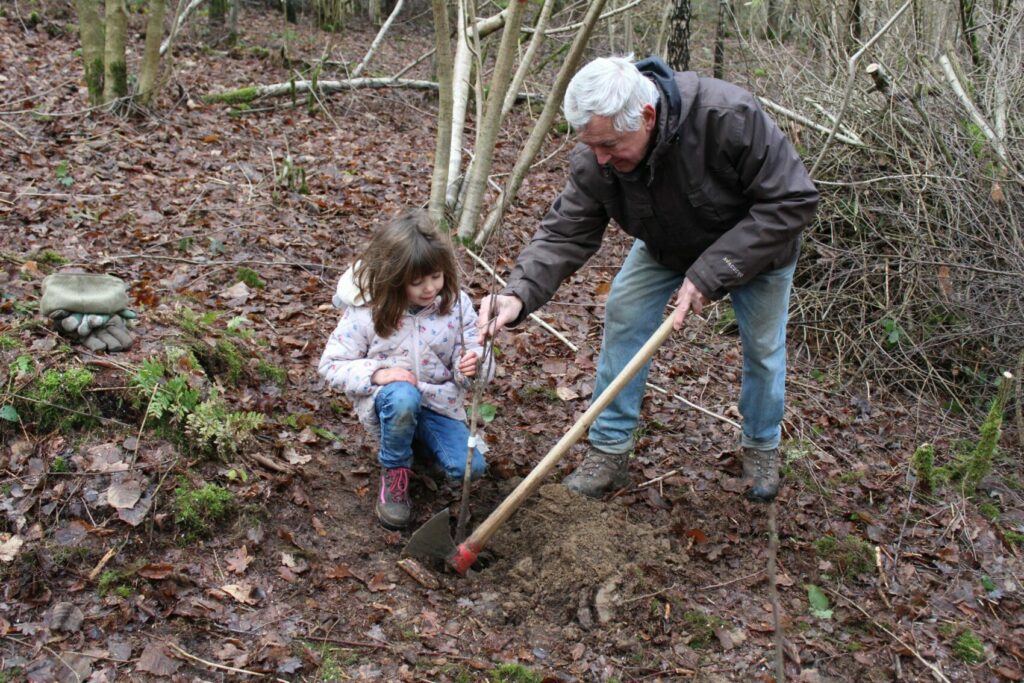
In addition to the silvicultural benefits of the technique, the Lump, Being a small management area (15-25 m²), it can reasonably be entrusted to a child at planting time. They will, of course, participate in the planting and will visit the site once or twice a year. Klump with their elders to carry out the maintenance. Light clearing in the first few years can be done manually given the small surface area. This «intensive» monitoring phase takes place at an age when children are still very open and willing. The next phase, which can last from 15 to 30 years depending on the species, no longer requires much attention. It corresponds to the adolescence and the often busy young adult life of the planter, who will reconnect with their trees at the time of the first thinning. What satisfaction then for the «young managers» to see the future trees of the stand emerge among the trees they planted.
They tested and adopted the action Klump
At Charles de Favereau's, at Jenneret, 9 Klumps were planted with his nephews and nieces. «The project appealed to me because it allowed me to get my nieces and nephews interested in the woodlands they will one day be responsible for, not only those who already had a certain interest in them but also others, and it answered a latent curiosity. I see some of them very keen to take a walk in the woods with their uncle and listen to his explanations. The value of taking ownership of a Klump I hope the holder will wish to follow «their» trees over time and, hopefully, take a liking to it. I am certain that everyone will ask to see the evolution of their Klump. »
At Guy Boodts in Yvoir, 2 Klumps were planted with his children and grandchildren: «By bringing together two or three generations, this project Klump allows for encounters, listening, knowledge sharing, management and a promise for our woodland's future. On a site destined for family inheritance, this project allows us to hope for and support the sustainable and harmonious management of our forest. My five grandchildren, who are involved in the project, are still young (aged 2 to 9) and had not yet felt concerned by the property, let alone its future. They do now.»
Find out more here the article dedicated to the first Klumps planted during the winter of 2018-2019 and a few testimonials from convinced grandparents.
Would you like to instil a passion for the forest in your children or grandchildren?
RFSB can help you with your project.
In concrete terms, RFSB offers:
- a visit from a forestry coach (specially trained) to work with the owner on the choice of plot, species and planting plan. This visit generally takes place between June and September. The summer holidays are a good opportunity to get the children involved right from the design stage.
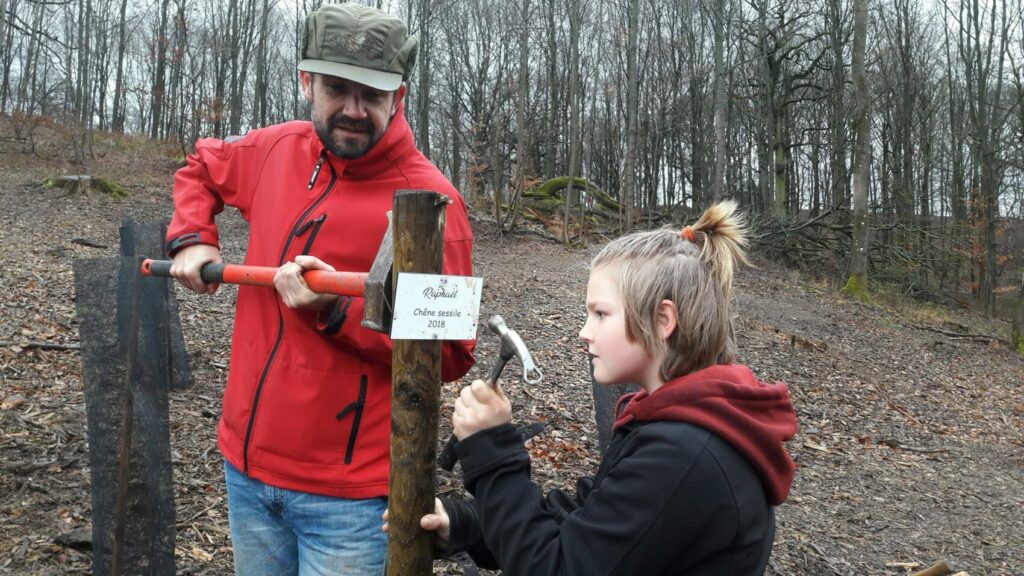
- the presence of a coach during the planting to supervise the children (planting, fitting of game protectors) and to explain the principle to them.
- a technical data sheet to be kept with maintenance instructions for the Klump.
- a brochure designed to help children manage their own little corner of the forest, in which they can record their observations.
It is advisable to place a central stake in the centre of the klump to help locate and identify it. A sign with the name of the child, the date of planting and the name of the species can be placed there.
Instructions for printing the sign :
You choose a local printer or an online printer (Vedi, Helloprint, VistaPrint).
You are preparing the PDF to send to them:
- On a horizontal Word, write the child's first name, the species planted and the year it was planted.
- To convert it to PDF, click on "Save as". Change the Word format to PDF. This is the format you will send to the printer.
Our advice for your order:
- The 10 x 20 format is sufficient
- Dibond (aluminium composite panel) or Forex
- Provide 2 fixing holes
Implement this action in your woods
Contact Julie Losseaujulie.losseau@srfb-kbbm.be)